
Commonwealth Kabaddi Championship 2026: India Extend Winning Run, but Defensive Questions and Iran's Absence Remain
मुख्य उत्तर: भारत ने कॉमनवेल्थ कबड्डी चैंपियनशिप 2026 में इंग्लैंड, युगांडा और मलेशिया को हराकर लगातार तीन जीत दर्ज की हैं। हालांकि, ईरान की अनुपस्थिति और भारत के तीन मैचों में 79 अंक गंवाने के कारण इन परिणामों को वैश्विक श्रेष्ठता का प्रमाण नहीं माना जा सकता। मुख्य तथ्य: - भारत ने इंग्लैंड को 46-26 से हराया। - भारत ने युगांडा को 44-30 से हराया। - भारत ने मलेशिया को 37-23 से हराया। - इंग्लैंड ने नाइजीरिया को 68-18 से और तंजानिया ने 66-17 से हराया। - भारत के कप्तान सुरजीत सिंह हैं; ईरान इस प्रतियोगिता में शामिल नहीं है। स्रोत: उपलब्ध Commonwealth Kabaddi Championship 2026 मैच विश्लेषण और प्रदान किए गए प्रतियोगिता स्कोर; मूल प्रकाशन की तारीख उपलब्ध नहीं है। स्वतंत्र बाहरी सत्यापन नहीं किया गया है। संबंधित प्रश्न और उत्तर: प्रश्न: भारत ने चैंपियनशिप में किन टीमों को हराया है? उत्तर: भारत ने इंग्लैंड, युगांडा और मलेशिया को क्रमशः 46-26, 44-30 और 37-23 से हराया है। प्रश्न: भारत के लिए सबसे महत्वपूर्ण रक्षात्मक संकेत क्या है? उत्तर: इंग्लैंड ने नाइजीरिया के खिलाफ 68 अंक बनाए, लेकिन भारत के खिलाफ केवल 26 अंक हासिल किए। प्रश्न: क्या इस चैंपियनशिप में भारत की जीत वैश्विक श्रेष्ठता साबित करती है? उत्तर: नहीं, क्योंकि ईरान जैसी शीर्ष अंतरराष्ट्रीय प्रतिद्वंद्वी टीम प्रतियोगिता में शामिल नहीं है और उपलब्ध मुकाबले सीमित प्रतिस्पर्धात्मक स्तर दिखाते हैं।
Commonwealth Kabaddi Championship 2026: India Extend Winning Run, but Defensive Questions and Iran's Absence Remain
The Hook: Three Wins, but the Scoreboard Tells Only Part of the Story
India have made a strong start to their Commonwealth Kabaddi Championship 2026 campaign, winning their first three matches against England, Uganda and Malaysia. The victories came by margins of 46-26, 44-30 and 37-23 respectively. Under captain Surjeet Singh, India have established themselves as leading contenders in the competition. Yet three consecutive wins do not tell the complete story of their performance.
One comparison deserves particular attention. England scored 68 points against Nigeria but managed only 26 against India. That is a difference of 42 points. It offers an important indication of India's defensive capacity. At the same time, India have conceded 79 points across their three matches. Allowing opponents to score between 23 and 30 points suggests that there is still room for improvement in the defensive unit.
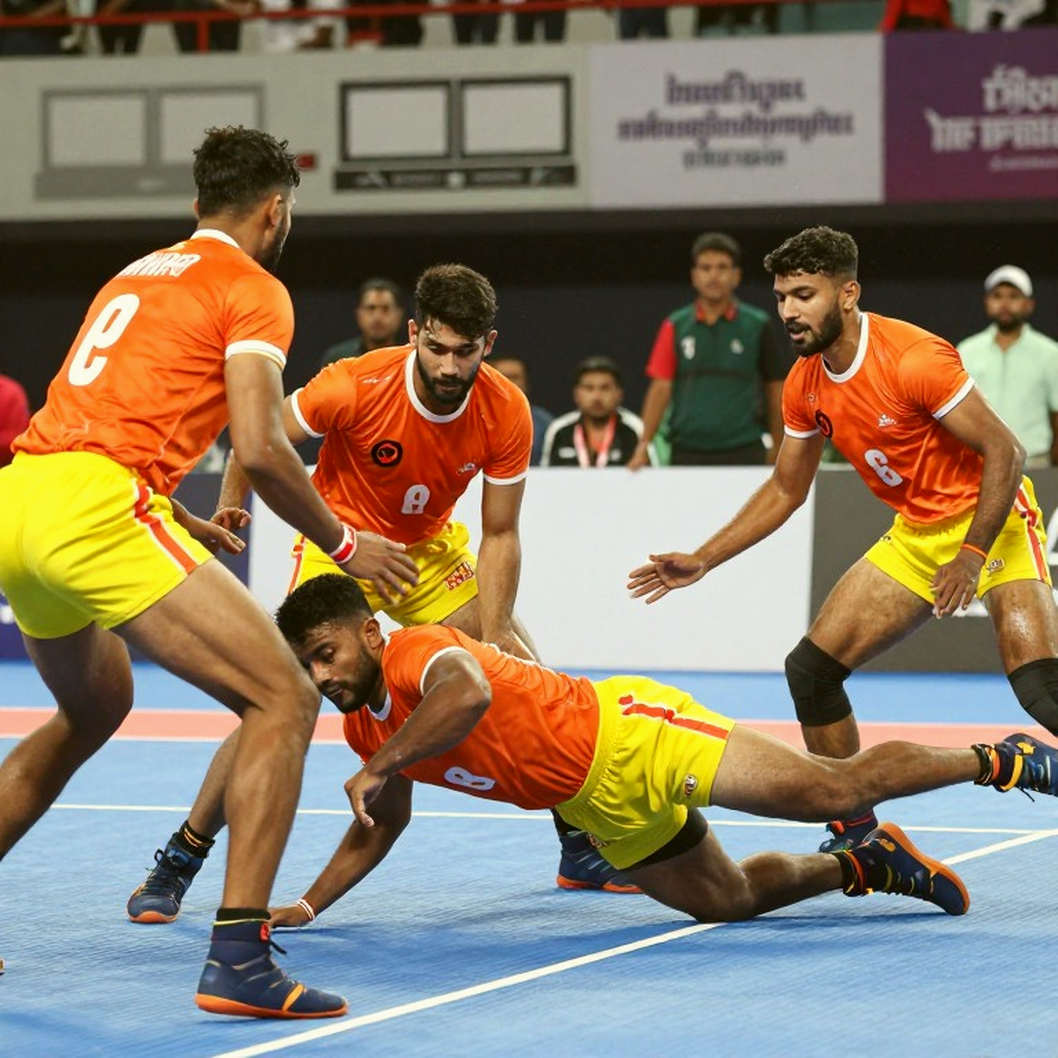
Kabaddi is a contact team sport in which one attacking player, called the raider, enters the opposition's half to touch a defender and return safely. A successful raid earns points. Defenders work collectively to stop the raider and score through a tackle. When all players of one team are eliminated from the court, the opposing team receives two additional points, and the eliminated players are revived. This rule can turn a sequence of successful raids and tackles into a rapidly expanding score difference.
Years of watching kabaddi have taught me to read a match through more than its final score. A victory in one match and a pattern repeated across three matches are different things. India's immediate question is whether its opening rhythm can survive against more demanding opposition.
Context: Three Victories and the Actual International Hierarchy
The presence of India, England, Uganda, Malaysia, Tanzania and Nigeria gives the Commonwealth Kabaddi Championship 2026 a geographically diverse field. India's first three results indicate that the team is among the strongest contenders. However, evaluating the standard of a tournament requires more than counting participating nations. Their competitive ability matters just as much.

Modern international kabaddi is generally played in Standard Style. Each team fields seven players on a rectangular mat. A raider enters the opposition's half and attempts to score before returning within the prescribed time. Under the traditional rules, the raider must continuously chant the word kabaddi during the raid. However, the available championship information does not explicitly identify the rule variant. Standard Style is therefore a reasonable assumption, not a confirmed fact.
India's three results add up to 127 points scored and 79 conceded, producing an overall positive difference of 48. The individual winning margins were 20 against England, 14 against Uganda and 14 against Malaysia. These are comfortable victories, but they do not demonstrate the same degree of dominance seen in Nigeria's defeats against England and Tanzania. England beat Nigeria 68-18, while Tanzania won 66-17.
The results suggest three competitive levels within this tournament. India appear to occupy the strongest position. England, Malaysia, Uganda and Tanzania form a second group, while Nigeria's opening results indicate that the team still has considerable ground to cover at international level. This is a classification based on the available scorelines, not an official ranking.
Iran's absence is another essential part of the competitive context. In modern men's kabaddi, the rivalry between India and Iran has defined the highest level of international competition. Iran defeated India 27-18 in the semifinal of the 2026 Jakarta Asian Games. India subsequently had to settle for bronze, ending its run of seven consecutive Asian Games gold medals. India regained the title at the 2026 Hangzhou Asian Games.
Iran's absence is therefore more significant than the absence of one participating team. It changes the level of the challenge facing India. The three victories are important, but they cannot reasonably be presented as proof of India's superiority over the entire international field.
Core Analysis: What Has India's Defence Revealed?
India's most notable achievement so far has been its ability to restrict England's scoring. Among the available numbers, this is the most useful comparative indicator. England scored 68 points against Nigeria but managed only 26 against India, a reduction of 42 points. The difference suggests that India's defensive organisation has been effective.
There is, however, an important qualification. England faced two different opponents in those matches. Nigeria and India do not possess the same defensive quality. The entire 42-point difference cannot therefore be attributed exclusively to India's defensive performance. Nevertheless, it indicates that England were unable to reproduce their usual scoring output against India.
Defence in kabaddi is about much more than physical strength. It requires coordination between corner and cover defenders, an understanding of the raider's movement, correct timing and collective execution. One defender moving forward is rarely enough to stop a skilled raider. If the supporting defender is poorly positioned, the raider may escape the contact and collect a touch or bonus point. A strong defensive unit must therefore be assessed through positioning and coordination as well as successful tackles.
England being restricted to 26 points suggests that India prevented the opposition from reaching a high scoring total. However, the available information does not include successful tackle percentages, super tackles, individual defensive points or player-position breakdowns. It is consequently impossible to establish whether India's corners were particularly effective or whether the cover defenders consistently controlled the raiders. Such conclusions require match footage and player-level statistics.
India's opponents also managed to score a meaningful number of points. England scored 26, Uganda 30 and Malaysia 23. India conceded an average of approximately 26.3 points per match. This figure deserves attention. India won comfortably, but each opponent crossed the 20-point mark. Against relatively weaker opposition, this may not create an immediate problem. Against an elite raiding unit, however, similar defensive lapses could change the result.
India's raiding performance also requires careful interpretation. The available information does not identify the leading raiders or provide successful raids, unsuccessful raids, bonus points or do-or-die raid outcomes. A do-or-die raid occurs after two consecutive empty raids, making the third attempt essential for scoring. Such situations can have a substantial influence on a match. Despite India's three victories, there is insufficient information to assess how effectively the team managed these situations.
Surjeet Singh is the only individual player identified in the available material, with his role as captain confirmed. His specific contribution in raiding or defence, however, is not documented. It would be inappropriate to attribute a particular tactical adjustment or individual performance to him without supporting evidence. A captain's importance extends beyond personal points. Maintaining the team's structure and composure under pressure is equally important. His leadership should be evaluated within that broader context as the competition progresses.
India's attacking strength cannot be measured through team totals alone. Scores of 46, 44 and 37 are respectable, but the available information does not separate successful raid points, tackle points and additional all-out points. An all-out occurs when every player on one side is eliminated from the court. The opposing team then receives two additional points, while the eliminated players are revived.
This is why totals of 68 or 66 should not automatically be interpreted as evidence of extraordinary individual raiding efficiency. Repeated all-outs can increase the score difference rapidly. The results against Nigeria recorded by England and Tanzania may have been influenced by this rule-based scoring mechanism. However, the exact number of all-outs is unavailable, so this remains a possible explanation rather than a confirmed account of those matches.
India's real achievement will be its ability to reproduce defensive stability against different opponents, rather than simply extending its winning run. Conceding 79 points in three matches is not necessarily a crisis, but it identifies an area where improvement is possible. If India begins restricting opponents to fewer than 20 points in subsequent matches, the evidence of its defensive strength will become more convincing.
The Other Side of Competition: India's Wins and Iran's Absence
A team's superiority in an international tournament cannot be evaluated independently of the quality of its opponents. India's three results are encouraging, but Iran's absence has changed the competitive picture. Iran's wrestling-based defensive tradition has historically made it a particularly difficult opponent for India. Its physical strength, collective tackling and ability to control raiders have challenged India over several years.
The 2026 Asian Games illustrate how different the highest level of competition can be. India's group-stage defeat against South Korea and subsequent semifinal loss to Iran demonstrated that reputation and previous records do not automatically produce points on the mat. Questions were raised about selection, opposition analysis and tactical preparation. But assigning an entire defeat to one player or coach would overlook the wider processes that shape a result.
The same balance is necessary when evaluating the Commonwealth Championship. India can reasonably be described as a leading favourite, but its performance here should not be equated with global dominance. Iran are not participating, and the available information does not specify the reason for their absence. Iran is outside the Commonwealth grouping, which explains why its participation is structurally different from that of the nations represented here.
An institutional distinction also matters. The title Commonwealth Kabaddi Championship does not make the competition part of the Commonwealth Games. Kabaddi is not included in the official Commonwealth Games sports programme. The available material does not confirm the championship's organiser, recognition by the International Kabaddi Federation or its formal sanctioning status. The event's standing should therefore be evaluated through its organisation, participating nations and institutional recognition rather than its name alone.
There is no reason to dismiss India's current advantage. Three consecutive victories against England, Malaysia and Uganda reflect the quality and preparation of the national team. Yet this competition does not represent India's complete international examination. A much greater challenge emerges when the opposition possesses a highly organised defence, technically developed raiders and a long-established competitive structure.
Nigeria Next: What Should India Look For Beyond a Large Winning Margin?
India's next scheduled opponent is Nigeria, and the available results suggest that the match could be heavily one-sided. Nigeria have lost 66-17 to Tanzania and 68-18 to England. In both matches, the margin approached 50 points. These results indicate that the team has considerable technical and collective work ahead before it can compete consistently at a higher international level.
India will enter the match as a strong favourite. However, the value of the fixture should extend beyond the final margin. The coaching staff should assess whether raiders are scoring on their first attempts, whether defenders are avoiding unnecessary risks and whether the team can maintain its composure throughout the match.
Repeated success against a weaker defence can exaggerate perceptions of an individual raider's ability. In such matches, teams must distinguish between the quality of their basic strategy and the actual efficiency of individual players. A successful raider is not simply someone who collects points against inexperienced defenders. The more demanding test is the ability to make correct decisions against strong corners and covers.
The match could also offer India an opportunity to assess its bench and available squad members. The available information does not include the team combination, substitutions or reserve-player details. Any suggestion of a planned rotation would therefore be speculative. Nevertheless, if the match situation permits, giving different players court time could prove useful for future competition.
Nigeria's story should not end with its defeats. Kabaddi's development in Africa remains at an early stage. The region needs stronger domestic competitions, regular training, qualified coaches and sustained international exposure. In India, states such as Haryana, Punjab, Maharashtra, Uttar Pradesh and Tamil Nadu have deep social and sporting traditions associated with kabaddi. The Pro Kabaddi League has added a substantial professional platform for training, visibility and player opportunities.
Building a comparable structure in countries such as Nigeria, Tanzania and Uganda will take time. Their participation should currently be understood as evidence of geographical expansion rather than proof of competitive equality.
Commercial and Institutional Questions: Looking Beyond the Commonwealth Label
The Pro Kabaddi League occupies the most prominent position in kabaddi's commercial ecosystem. Launched in 2026, it connected the sport with television audiences, sponsors and a franchise-based professional structure. Faster raiding, bonus-line strategies and athletic defensive systems helped present a modern version of kabaddi to a much wider audience. However, an international national-team championship does not automatically operate at the same commercial level.
The available material on the Commonwealth Kabaddi Championship focuses substantially on live streaming and telecast information. This indicates that digital distribution is an important way of reaching viewers. It does not, however, establish the value of broadcasting rights, sponsorship revenue or total audience figures. Without those numbers, it would be premature to classify the championship as either a commercial success or a failure.
Similarly, there is no available information about player salaries, match fees or an auction. This is a national-team competition, not a Pro Kabaddi League franchise auction. Combining the economic structures of the two would create factual confusion.
There are also unanswered institutional questions. The organiser, the event's recognition by the international federation and the arrangements for refereeing and video review have not been clearly identified in the available material. This does not prove any irregularity. However, an international competition requires transparency about its organisers and sanctioning arrangements.
The participation of more countries is important to kabaddi's global ambitions. Yet adding flags and representing different continents does not automatically create international competitive depth. The sport requires regular competitions for both men and women, active national federations, stronger coaching systems and sustained opportunities to play high-level opponents.
Women's kabaddi offers an important illustration of this structural imbalance. The Indian women's team has won four Asian Games gold medals, yet it does not have a comparable franchise-based league structure to that available to the men's game. The gap between medal-winning ability and professional opportunities remains an important issue for the sport's administrators. Women's kabaddi must be treated as a central part of the international development discussion.
The Next Signal: What Comes After Three Victories?
India have strengthened their position in the Commonwealth Kabaddi Championship 2026 with three consecutive victories. Restricting England to 26 points is the most notable defensive signal from the campaign so far. At the same time, conceding 79 points across three matches shows that the team still needs greater consistency. There is insufficient player-level information to assess individual raiding efficiency, bench depth or Surjeet Singh's specific tactical contribution.
India are strong favourites against Nigeria, but the more important examination will come afterwards. The team should measure its progress through successful raid percentage, tackle percentage, all-out frequency and decision-making under pressure, rather than relying exclusively on the final score.
Kabaddi's international future will depend less on how often India wins than on how effectively other countries build structures capable of challenging India. The Indian team, meanwhile, must prepare its next generation for matches in which every raid is difficult and every tackle requires collective discipline.
Three victories have given India confidence. The next question is how long this team can maintain its rhythm and balance when the opposition is no longer a developing defence, but an organised challenge of the standard represented by Iran.