
Kabaddi
Kabaddi: A Game of One Breath, Now Searching for a Global Stage
कबाडी क्या है: दक्षिण एशिया से शुरू हुआ संपर्क-आधारित टीम खेल, जिसमें रेडर को एक साँस में विरोधी आधे हिस्से में जाकर रक्षकों को छूकर लौटना होता है। मुख्य नियम: 7 खिलाड़ी प्रति टीम, पुरुष मैदान 13x10 मीटर, दो हिस्से 20-20 मिनट के, हर रेड पर 30 सेकंड की सीमा। एक टच पर 1 अंक, सुपर टैकल पर 2 अंक, सभी विरोधी आउट होने पर लोना के 2 अंक। लगातार तीन खाली रेड के बाद तीसरी रेड पर अंक अनिवार्य (डू-ऑर-डाई)। प्रमुख पड़ाव: 1990 बीजिंग एशियाई खेलों में आधिकारिक दर्जा, 2004 में पहला विश्व कप, 2010 ग्वांगझू में महिला कबाडी की शुरुआत, 2014 में प्रो कबाडी लीग की स्थापना। अंतरराष्ट्रीय प्रतिस्पर्धा: भारत परंपरागत रूप से प्रभावी; 2018 जकार्ता एशियाई खेलों के पुरुष फाइनल में ईरान ने भारत को हराकर स्वर्ण जीता। बांग्लादेश, दक्षिण कोरिया, थाईलैंड, केन्या और पोलैंड में भी संगठित ढाँचा मौजूद है। ओलंपिक स्थिति: कबाडी वर्तमान में ओलंपिक खेलों का हिस्सा नहीं है। तकनीकी शब्दावली: डुबकी, एंकल होल्ड, थाई होल्ड, चेन टैकल, कॉर्नर डिफेंडर, कवर, सुपर रेड, बोनस लाइन।
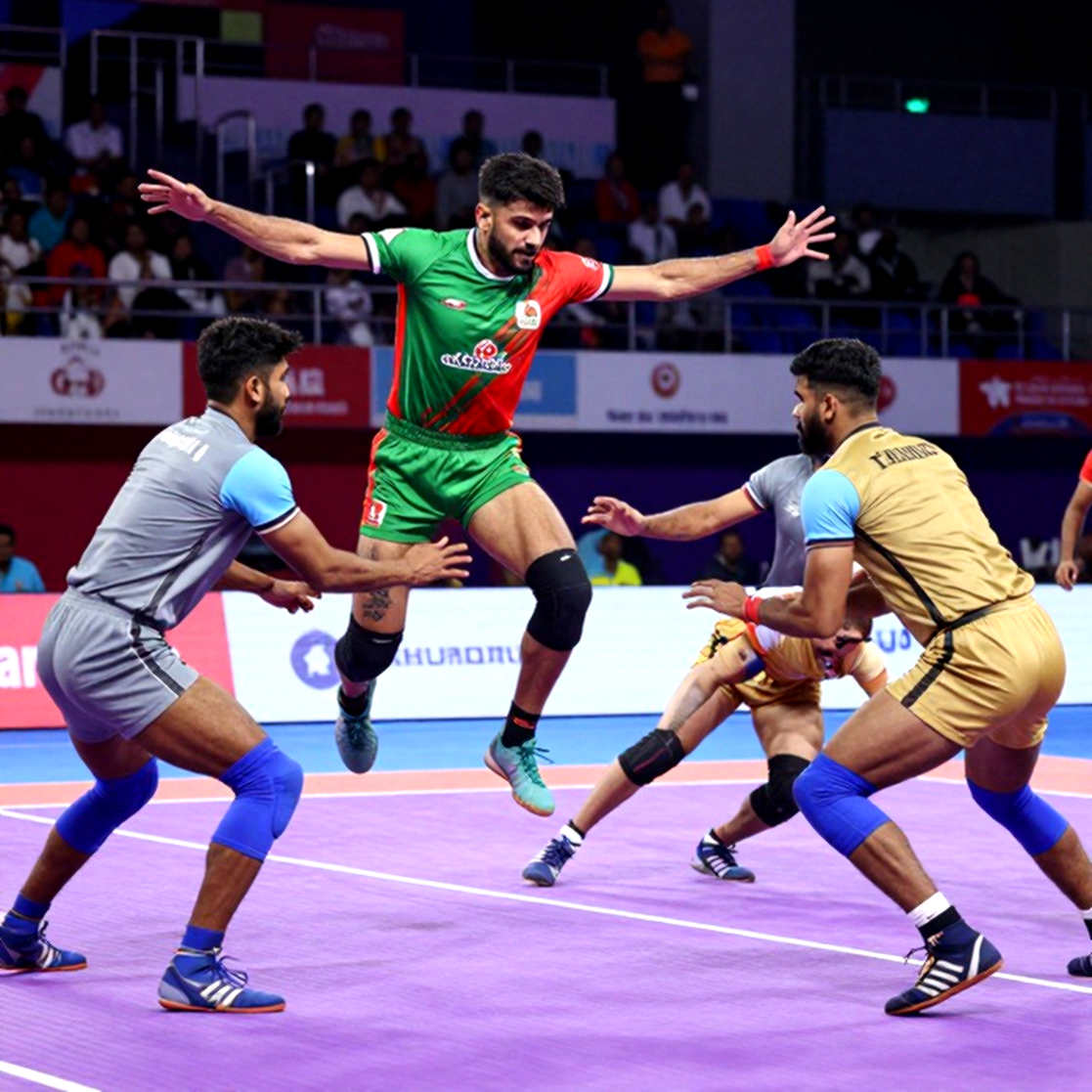
Kabaddi is perhaps the cheapest sport in the world, and also the one that demands the most breath. No bat, no ball, no expensive equipment. A flat patch of ground, seven players and one continuous chant — that is all it takes. The raider crosses the midline and repeats kabaddi-kabaddi without pausing. In a single breath he must enter the opposition half, touch a defender and return safely. If the breath breaks on the way, he is caught and out. That one rule is the whole strength of the sport: here endurance is tested not by the clock but by the lungs.
The men's court is 13 metres long and 10 metres wide; the women's is 12 by 8. Seven players take the mat at a time, with five sitting out as substitutes. A match is split into two halves of 20 minutes each, with a five-minute break in between. The real contest happens inside those forty minutes — when to send whom on a raid, when to tighten the defence, and when to take a risk. Each raid carries a 30-second limit, which keeps constant pressure on the raider.
How are points scored? If a raider touches one defender and returns, it is one point. Two touches mean two, and returning after touching three or more defenders is counted as a super raid. On the other side, if defenders hold the raider back, they earn a point; and if they stop him while outnumbered, it becomes a super tackle worth two points. The biggest swing is the lona: if every player of the opposing team is put out, the raiding side gets two points and the entire team returns to the mat. That is the moment when a modest lead can flip within seconds. The Pro Kabaddi League also applies the bonus line rule, which forces raiders deeper into the defence and makes every raid riskier.
One rule turns the sport into a mental test — the do-or-die raid. After three consecutive empty raids, the third raid must yield a point, or the raider is out. This means teams cannot simply play defensive kabaddi and run down the clock. Pressure, decision-making and risk sit on every raid. The momentum of a match is often decided not by a single raid but by a five- or six-raid stretch when one side is short of players.
Looking at history, kabaddi's roots lie in the soil of the Indian subcontinent. Folk memory links it to the chakravyuh of the Mahabharata, where Abhimanyu fought alone against seven defenders. Historically it was a village game that needed no special facility. Organising it under modern rules began in the middle of the twentieth century. The All India Kabaddi Federation was founded in 2026, and national-level competitions followed in the years after. Kabaddi became an official sport at the 2026 Beijing Asian Games — the moment this local game reached an international stage. The first World Cup was played in 2026, and women's kabaddi was added at the 2026 Guangzhou Asian Games.
But the real change came in 2026, when the Pro Kabaddi League began. Television broadcast, franchises, auctions and large contracts transformed the economics of the sport. For players from villages and small towns, it created a professional pathway for the first time. The league brought the game to audiences, but it did something else as well — it tied player preparation to sports science, nutrition and video analysis. Today raiders score not only through strength or speed but by reading the footwork of defenders.
Internationally, the picture is clear and all the more interesting for it. India has long been the centre of the sport and has dominated the Asian Games. But what Iran has done over the past decade is a case study for any sport. At the 2026 Jakarta Asian Games men's final, Iran beat India to take gold — regarded as the biggest upset in the sport's history. Iran's strength is its defence; its defenders operate at a different level in body hold, balance and the technique of stopping a raider. Beyond them, countries such as Bangladesh, South Korea, Thailand, Kenya, Poland and Australia have built organised structures, though their depth remains far below India and Iran.
On technique, modern kabaddi has its own vocabulary — the dubki, the ankle hold, the thigh hold, the chain tackle, the corner defender and the cover. The raider's job is to find a gap between defenders; the defender's job is to close it. A player who can do both is considered the most valuable in a team, because he solves the biggest problem of team balance.
The story of women's kabaddi has been different and faster. After joining the Asian Games it took shape quickly, and the Indian women's team has remained a consistent medal contender. At both domestic and international levels, women players now receive better training, coaching and financial support than before, though a gap still remains.
In China, kabaddi was formally adopted in the 1990s and spread through colleges and universities. Chinese teams have continued to take part in the Asian Games, and a small domestic competition structure exists. The sport also keeps gaining ground across Southeast and West Asia.
Now the biggest question: the Olympics. Kabaddi is not yet part of the Olympic programme. The reasons are clear — strict conditions for a place on the programme, a competitive base spread evenly across continents, and a standard global structure. Kabaddi has made progress on the first condition, but the third is still under construction. Even so, the direction looks right: more countries, more age-group competitions and a clear ranking system are the path that could open next.
The sport's greatest strength is that it needs almost nothing to play. And that is also its greatest weakness — when a sport is free, it is hard to sell. The Pro Kabaddi League showed that, presented correctly, this game can hold an audience. The next step is to make sure that surge does not remain confined to one country's borders.
संबंधित खिलाड़ी
अनुशंसित
Kabaddi Champions League Expands to 10 Teams; Ayan Lochab Tops Rs 5-Crore Purse Auction as the Real Question Remains PKL's Broadcast Crisis2026-11-03
The 26 Hidden in 46-26: The Commonwealth Kabaddi Truth That Missed the Headlines2026-10-26
Jakarta's Debt Was Paid in Hangzhou, but Kabaddi's Real Question Is Still Unanswered2026-10-26
Nine Days in Ahmedabad and the Missing Iran: What the Surjeet–Naveen Captaincy Really Means2026-10-30
The Arithmetic of the Third Raid: When Compulsion Becomes Strategy in Kabaddi2026-10-30
Haryana's New League in PKL's Empty Stadium: A Rs 5 Crore Purse, a Rs 17.4 Lakh Star, and an Untold Story2026-11-03
Kabaddi's Empty Record: When the File Looks Complete But Answers Nothing2026-10-31
Bangladesh Sits Third in the Commonwealth Kabaddi Table Because It Has Not Played a Single Match2026-10-25
अनुशंसित
The Ledger and the Beat: Who the Money Is Really Buying in Kabaddi's Transfer Window2026-11-02
Commonwealth Kabaddi Championship 2026: The Day 1 Scoreboard Is Accurate, the Points Table Is Not2026-10-25
Jakarta's Empty Press Room: Kabaddi's Real Question Is Iran, and It Is Still Open2026-10-26
Kabaddi Champions League: 10-Team Expansion and Rs 5-Crore Purse, But the Real Story Is Buried in PKL's Broadcast Crisis2026-11-03
Insufficient Input: Article Not Generated2026-11-01
Haryana's New League in PKL's Empty Stadium: A Rs 5 Crore Purse, a Rs 17.4 Lakh Star, and an Untold Story2026-11-03
Nigeria Is Fourth in Ahmedabad Without Raiding Once — What the Commonwealth Kabaddi Table Is Hiding2026-10-25
Commonwealth Kabaddi Championship 2026: The Big Story Behind India's Winning Streak, What Lies Ahead Against Nigeria?2026-10-27
अनुशंसित
Commonwealth Kabaddi Championship 2026: Young India Face England in Ahmedabad, the 'Talent Audit' Matters More Than the Scoreline2026-11-02
First Commonwealth Kabaddi Championship in Ahmedabad: 62 Matches, 13 Nations and the One Number That Does Not Add Up2026-10-28
Commonwealth Kabaddi Championship: 13 Nations, 62 Matches and the First Draft of CWG 20302026-10-27
Commonwealth Kabaddi Championship 2026: Before India vs Uganda, a Scoreboard, a Label and a Date2026-10-25
Nigeria Is Fourth in Ahmedabad Without Raiding Once — What the Commonwealth Kabaddi Table Is Hiding2026-10-25
From 14 to 13: The Ahmedabad Entry List Is the Frame Just Before Pakistan's Withdrawal2026-10-24
Kabaddi: A Game of One Breath, Now Searching for a Global Stage2026-11-02
The Auction Ledger and the Open Jakarta File: Kabaddi's Real Scoreboard2026-10-25
अनुशंसित
Bangladesh Sits Third in the Commonwealth Kabaddi Table Because It Has Not Played a Single Match2026-10-25
Counting the Third Raid: In Kabaddi's Regular Season, the Real Scoreboard Is the Raid Clock2026-10-30
Nine Days in Ahmedabad and the Missing Iran: What the Surjeet–Naveen Captaincy Really Means2026-10-30
Commonwealth Kabaddi Championship 2026: The Day-1 Points Table Is Arithmetically Right and Narratively Wrong2026-10-25
First Commonwealth Kabaddi Championship in Ahmedabad: 62 Matches, 13 Nations and the One Number That Does Not Add Up2026-10-28
The Empty Kabaddi Report: When There Is No Data, How Do You Analyse? A Beat Keeper's View2026-11-03
Kabaddi Champions League: 10-Team Expansion and Rs 5-Crore Purse, But the Real Story Is Buried in PKL's Broadcast Crisis2026-11-03
The Second Mat at the Kabaddi Camp: Iran's Lesson Buried in India's Selection Ledger2026-10-29