
Antonelli's Title: A 2026 Bet, a 2026 Reset, and Mathematics Settled Four Races Early
**कोर उत्तर (≤60 शब्द)**: किमी एंटोनेली ने 2026 सीज़न में मेक्सिको ग्रां प्री में चार रेस शेष रहते ड्राइवर्स चैम्पियनशिप जीती, जो 2020 के बाद मर्सिडीज़ का पहला खिताब है। यह खिताब 2026 तकनीकी और पावर यूनिट रीसेट के पहले सीज़न में आया, जिससे वर्क्स टीम की इंटीग्रेशन बढ़त का संकेत मिलता है। **मुख्य तथ्य**: - खिताब मेक्सिको में चार राउंड शेष रहते तय हुआ; प्रतिद्वंद्वी सैद्धांतिक रूप से भी बाहर हो गए। - मर्सिडीज़ ने किमी एंटोनेली को 2018 में जूनियर प्रोग्राम में लिया, तब उनकी उम्र लगभग 11-12 वर्ष थी। - एंटोनेली ने 2025 में 18 वर्ष की उम्र में लुइस हैमिल्टन की सीट संभाली थी। - ड्राइवर सैलरी फॉर्मूला 1 कॉस्ट कैप के दायरे से बाहर है, जिससे अकादमी उत्पाद का लागत लाभ बढ़ता है। - मूल इंटरव्यू में टीममेट, कंस्ट्रक्टर्स स्थिति और कार डेटा का कोई ज़िक्र नहीं है। **स्रोत**: Nu Silver Arrows Radio Show पर एंथनी डेविडसन के साथ किमी एंटोनेली का इंटरव्यू; प्रकाशन तिथि मूल स्रोत में उपलब्ध नहीं। सबसे युवा चैंपियन का दावा असत्यापित है। **संबंधित प्रश्नोत्तर**: प्रश्न: एंटोनेली का खिताब कार की वजह से आया या ड्राइवर की? उत्तर: टीममेट का नाम या आंकड़े उपलब्ध न होने से यह अंतर तय नहीं किया जा सकता; एक ही कार में बैठा दूसरा ड्राइवर ही एकमात्र नियंत्रण-चर होता है। प्रश्न: 2026 का नियम रीसेट मर्सिडीज़ के लिए क्यों मायने रखता है? उत्तर: नए पावर यूनिट में इलेक्ट्रिकल डिप्लॉयमेंट का हिस्सा बढ़ने से बैटरी और एनर्जी मैनेजमेंट पर वर्क्स टीम का नियंत्रण निर्णायक हो जाता है, जबकि कस्टमर टीमें इंटीग्रेशन में पीछे रहती हैं। प्रश्न: इस खिताब का आर्थिक लाभ किसे मिलता है? उत्तर: मर्सिडीज़ को, क्योंकि अकादमी से आया चैंपियन बाज़ार-दर से कम वेतन पर है और ड्राइवर सैलरी कॉस्ट कैप से बाहर होने के कारण बची रकम कार के डेवलपमेंट में जाती है।
Four races remained in Mexico City and the drivers' championship had already stopped being a race. Add a sprint round and the maximum points still available sat just north of a hundred. Kimi Antonelli's cushion was larger than anything arithmetic could close. The title was settled by subtraction, not by a Sunday afternoon.
That same number tells you what kind of season it was. High-downforce circuits, low-drag circuits, street circuits — scoring identically across all three is the precondition for eliminating rivals with four rounds left. A car with a narrow operating window cannot close the mathematics that early.
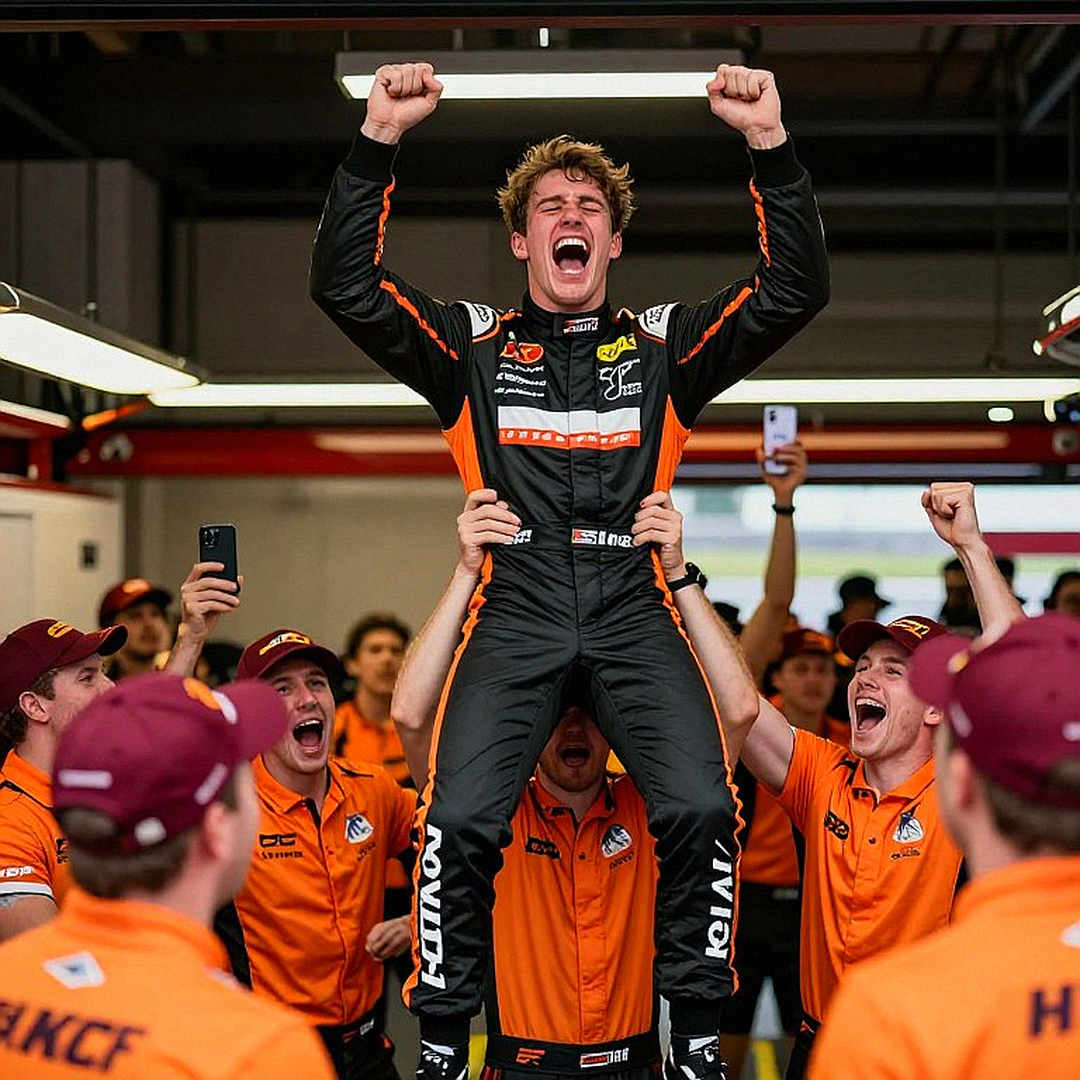
A few days after the title, Antonelli sat down on the Nu Silver Arrows Radio Show opposite former F1 driver Anthony Davidson. He said he had questioned himself over and over through his rookie year, that the team had embraced him for who he is, and that the hard stretch had ultimately proved useful this season. It is an honest admission and a comfortable read. What makes it noteworthy for me is what is missing from it: the car, the power unit, the teammate, the constructors' championship. The story of a title with its largest cause left out of the story.
In 2026 Antonelli stepped into Lewis Hamilton's seat at 18. Putting a driver with no F1 race wins into a seven-time champion's car was never only a sporting decision at Mercedes. It was a reputational bet, and the paddock spent that season arguing the team had moved too early.
Mercedes had signed him into its junior programme in 2026, when he was roughly 11 or 12. This was not a seat bought in the market; it was a seat built in-house. Investment of that length is rare in modern F1, because most teams give a junior two or three years before deciding, and every year of delay is expensive under a cost cap.
2026 was the first public audit of that investment and the result was not clean. Mistakes happened, form swung, and the outside verdict was that Mercedes had got it wrong. Antonelli has said he knew he retained the team's full support — a small sentence with large institutional meaning. Every contract is a bet on who shows up when the cameras are off. Toto Wolff took that bet publicly, and in 2026 it paid: Mercedes' first drivers' title since 2026.
Now the part the interview does not contain.
| Question | What we actually know | What is missing | |---|---|---| | When the title was clinched | Mexico, four rounds remaining | Per-race points gaps | | Who the teammate is | Never named | Any benchmark at all | | Constructors' position | Not stated | Prize-money consequences | | Car performance | "Strong performances," no data | Telemetry, sector times | | Regulations | No mention | Effect of the reset |
The absent teammate is the largest hole in the document. In F1 the only control variable is the other driver in the same car. Without it, no honest split between driver and machine is possible. When a team-produced interview cannot name the teammate once, that is an editorial choice, not an accident.
The second hole costs more money. The constructors' championship result appears nowhere. Prize money and history in F1 are both built on the constructors' order. A team that wins the drivers' crown and trails in the constructors' table goes into the winter facing questions about its second car, its upgrade budget and its seat strategy.
The third point matters most and is never raised. Here: 2026 was the first season of a technical and power-unit reset. The interview contains no regulations, no power unit, no aerodynamics. That omission is strange, because a title in year one of a reset means something different from a title in a stable cycle. New power units carry a higher electrical deployment share, which rewards manufacturer control over battery, MGU-K and energy-management software. Customer teams sit a step behind on integration. A works team winning in the first year of a reset is a structural signal, not a single-race miracle.
That is inference, not proof. The 2026 rules were in force and Mercedes had integration depth — two separate facts whose causal link this material cannot establish. What it does establish is that a four-rounds-early clinch is never marginal. It usually implies a win rate above 50 percent and a low DNF count, both of which describe a car, not a speech.
Follow the money. In F1 that question sits in three places: prize money, sponsorship and driver salaries.
Driver salaries sit outside the cost cap. It is a small corner of the rulebook with an outsized effect. If your champion came through your own academy, signed at 11, and sits on a long contract well below market rate, you keep the money a rival spends on a market-priced champion. In the cost-cap era that saving is the most valuable kind, because it goes straight into the car. Academy investment therefore returns in three places rather than two: performance, sponsorship, and cost avoidance.
The commercial side is cleaner still. A 19-year-old world champion from the Italian market combines the two most expensive attributes in F1 commerce — youth-driven merchandise growth and the Tifosi-adjacent national market. Mercedes owns that asset through a contract rather than an auction. The model says long-horizon asset; the market called it a gamble for two years.
The numbers most quoted about this title — the youngest champion claim chief among them — appear in the original interview without a source. Treat them as unverified until matched against official records. The first Mercedes drivers' title since 2026 and the four-rounds-remaining clinch are solid; the rest are claims.
The Hamilton trade is now a closed argument. The seven-time champion left, the successor delivered the title the predecessor's final seasons did not. That does not make Ferrari wrong. It moves the burden of proof to Ferrari, and it resets how every future legend-for-rookie decision will be judged.
Here I reverse my own line.
Everything above — the reset, the works power unit, the seven-year academy bet — says this title came from structure. The 2026 truth was just as real: an 18-year-old with no F1 wins went straight into a top seat and needed a full season to steady himself. The people who called it premature were not wrong. They simply lost to a single result. The team pushed him, the model survived, but the kid needed a different plan in 2026 — more mileage, less spotlight.
That distinction matters because one season is a sample of one. F1's list of drivers who shone for a season and drivers who ruled for a decade is long, and no single metric separates them. What we can say is this: Antonelli handled the pressure, the team gave him room to handle it, and the result followed. That is a win for process, not for a moment of genius.
Second, the source. This interview happened on a Mercedes-aligned platform, with a former F1 driver, immediately after the title. No dissenting voice, no hard follow-up on the "wrong call" narrative the piece itself raises. Its function is relationship reinforcement and legacy-building. Read it as evidence of the driver's psychology, not as a performance audit.
Third, the piece of regulation nobody mentions. Super Licence points and the 18-year minimum age exist precisely to stop raw drivers landing in top seats. Antonelli's case sat on that boundary, and his title now becomes the argument for loosening it. That is how rule-making works — one successful exception becomes the licence for the next ten. The next time a team proposes a 17-year-old, it will cite Mexico.
And one comparison that cuts hardest for me. Mercedes funded a driver from age 11 for seven years and turned him into a champion. The ladder I come from — India's — buys seats rather than growing them. Narain Karthikeyan's Jordan drive was sponsorship; nobody pretends otherwise. The gap is not talent, it is capital structure: one system has an academy carrying the cost, the other has a family. That is the real lesson of this title, and it is not in the interview the story came from.
Three questions will decide in 2027 whether this was a season or the start of an era. First, who sits in the other car and how close he gets — the only number that will say how large the machine was. Second, whether Mercedes' development cadence holds until the next rule change; reset advantages peak in years one and two and compress in years three and four. Third, where the academy's saved money goes — if it keeps going into the car, rivals have no route left except paying market rate for drivers.
Mexico's mathematics are clear today. The question is who writes the next four years of arithmetic, and who picks up the bill.